

The Internet Was Built for Humans. Now It’s for Agents.
We won’t click links much longer. We’ll send agents instead.

Hello all,
I was writing an investor update at the end of the year and found myself unusually excited while typing it.
Not because “Ting 2025 results” aren’t fun (they are), but because the most interesting part was describing where the internet is going, and how Ting is riding that wave.
At some point I stopped and thought: why am I only sending this to such a small distribution? (Who probably get emails like that all the time anyway...)
This topic is close to my heart because I love the internet. Always have.
Many, many years ago, I entered the workplace obsessed with it. I ended up working with companies like Yahoo and LinkedIn that were actively shaping it. Then I got a break that changed the direction of my career: a front-row seat to the next big wave, the social web.
Back in 2011 (15 years ago!), I wrote a very similar piece while guest writing for HuffPost. The internet was changing in a way that feels eerily familiar today.
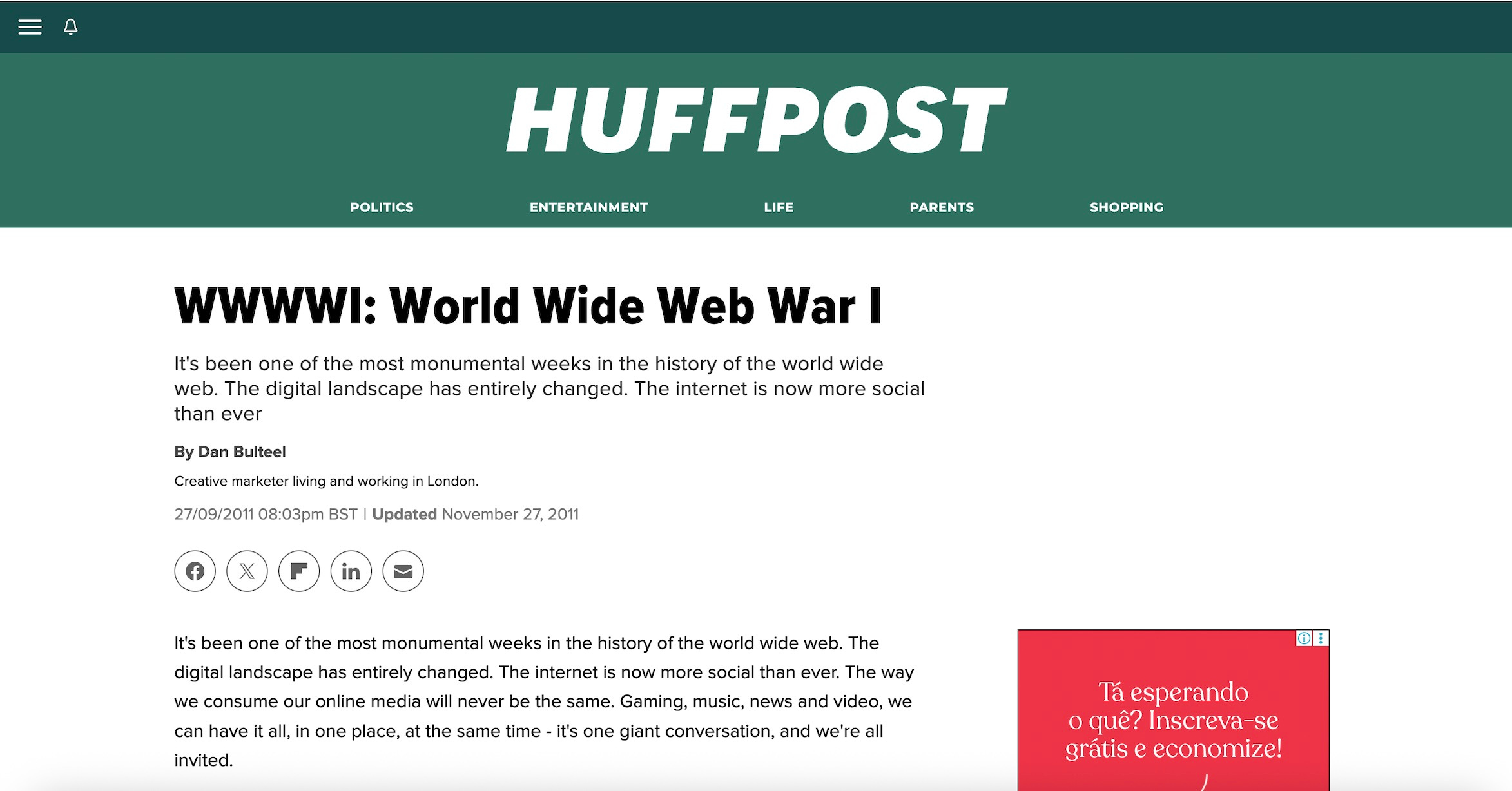
Facebook was updating the News Feed with a live ticker. Spotify and Zynga were being pulled directly into it. Google was launching Google+.
One of those changes fundamentally reshaped how we consume the internet. The other was a very loud signal that everyone had realised the shift was happening, even if they didn’t quite pull it off.
It feels similar today if you substitute social for AI.
The AI web. Or, to use the term du jour: the agentic internet.
That phrase is one of those buzz terms that means absolutely *nothing* to most people, so I want to use this article to make it dumb simple.
I’ll use Meet-Ting and scheduling as the main case study, but I’ll also try to show how this shift will show up in other ways I hope you’ll recognise too.
Beyond my love of the internet, I’m passionate (I began drafting this post on New Year’s Day to give some temperature to that…) about this because it creates a huge new swell of opportunity - for ideas, startups, and consumer value.
There are products that are so deeply ingrained in our behaviours that they suddenly may no longer make sense in this world. Which means startups can finally unseat incumbents that have felt immovable for years.
It’s that shaky snow globe moment when everything is up in the air and things start to settle in a new way.
Why this shift feels more radical
When social media became the front door to the internet, it collapsed a lot of things into a single feed. But those things were mostly connected by similar human needs: entertainment, connection, passing time.
This agentic shift is different.
If everything collapses into ChatGPT, Gemini, or similar systems, we’re talking about multi-need surfaces. Not just entertainment or social, but work, education, coordination, shopping - everything.
And this time, we don’t just have a feed.
We have an active intelligence alongside us.
The experience is more “sticky” because we’re navigating it with another presence.
We used to rely on push notifications and growth teams fighting to pull you back in. (I know, because I was one of them.)
Now it’s an intelligent presence with immense context about who you are, what you care about, and what you’re trying to do.
The gravity is easily 100x.
And that’s why it feels different - because it has the environment to happen more quickly.
I wrote that Huff Post piece in 2011 and I’d argue we didn’t hit peak social until 2019. ChatGPT launched in 2022 and you can easily see a world in which almost all of our online time starts there by 2027.
Explain the agentic internet like I’m 12?
Really simply:
The internet today was built to be human-read.
Everything about it - design, navigation, interaction - is optimised for the human eye and human hands.
But we’re now building agents to run tasks on our behalf.
And where do most tasks take place?
On the internet.
So we need to reconsider who is surfing the web.
For the next few years, it’ll be a mix of humans and agents. Eventually, it’ll be mostly agents.
Think about shopping agents.
An agent helping you buy groceries or track down a scarce item has a completely different experience of the web than you do.
Product discovery, speed, detection, purchasing - no clicks required.
Oh, and the rails to turn intent into transactions are already being laid. Visa has said that 2025 will be the final year consumers shop and ‘check out alone’, while Mastercard, PayPal, and Google have all launched protocols that allow AI agents to make purchases on a user’s behalf.
When I read this it felt like one of those “oh, this is coming” signals - whether we like it or not.
What does the agentic internet look like?
By now, hopefully you’re seeing and feeling how the agentic internet feels inevitable. But the exact shape is still a lil fuzzy.
One strong bet, though, just like Google collapsed search intent into a single browser, and Facebook collapsed social and entertainment into a feed, is that we end up with a new “home page” for the web.
And that home page is an LLM.
The two frontrunners right now are obviously ChatGPT and Gemini, both of which I called out in my recent hot takes piece.
With the launch of app stores and connectors inside these spaces, you can already access much of what you’d normally do on the web, but in a near-effortless way.
Meet-Ting is one of the early apps experimenting here. It’s really interesting to think about what it will mean for your product. There’s constraints for example how you onboard users when limited to a window in a window, but over time, you’ll get more and more of the full experience inside one place, through MCP-based UIs.
MCP-UI is effectively the UI layer for the Model Context Protocol. It lets tools and agents return richer, more interactive components, forms etc. directly inside an agent conversation.
That means agentic apps aren’t stuck in text-only flows like you experience today.
Now think about the knock-on effects.
If you just describe what you want and an agent goes and finds it, what happens to the rest of the web?
Advertising today is built on clicks and search behaviour. In an agentic world, we’ll need entirely new ad systems, ones that serve ads based on agent journeys, not human clicks.
The case study for meeting scheduling
Apart from my love of the internet, the other obsession in my life right now is time.
Specifically: how we trade time, coordinate, and how meetings reflect what we do (or don’t) care about.
Scheduling started out manually.
People emailed back and forth.
Availability slowly emerged.
Then booking links arrived.
Calendly deserves so, so much credit here. It offered an incredibly efficient way to share availability and let someone book directly.
I wanted to dislike it when I began with Ting, but the more I studied it, the more I realized it is still one of the best and most efficient ways for two people to get together.
But, there’s a but.
In an agentic world, it will no longer makes sense.
We won’t send emails and links. We’ll send agents.
In the old internet, it went:
Human → interface → human (email, links, DMs, calendars, forms)
Because the tools, Calendly included, assume:
Humans initiate.
Humans negotiate.
Humans resolve conflicts.
In the new internet, it looks more like this:
Agent → agent → human (intent first, logistics second)
And tools like Meet-Ting assume something different:
Humans set intent.
Agents do the rest.
Now if we zoom out and go all the way upstream to the start of our work day or online journey of the future:
You open your LLM: desktop, mobile, or voice. You talk about what you want. Agents go off and do the work.
You don’t send a link and ask someone to find availability.
That’s exactly the kind of thing agents should handle.
This is a fantastic moment for builders.
Because every category now needs to ask: what does this look like when behaviour changes and agents become first-class users?
That’s how incumbents get unseated.
What might slow this all down?
Two quotes from a recent MMC report frame the constraint really well:
“The biggest unsolved problem in AI agents is reliability at scale. A single agent can look 98–99% accurate, but once you chain multiple agents together, tiny error rates compound into business-critical failures.”
— Emma Burrows
“Agentic commerce won’t start with high-stakes purchases. It starts with low-value, repetitive decisions - groceries, takeaways, local services. That’s where trust is earned quietly, and where volume compounds until the rest of commerce flips.”
— Brendan Regan
That, to me, is the real arc ahead of us.
It won’t be a big bang moment, but a steady flow of upgrades and improvements that lead to user unlocks and adoption.
Building trust brick by brick, just like when we finally got over using our credit card details online for the first time.
Then, one day, you realise you don’t really do certain things anymore.
Your agents do.
And that’s the world we’re heading towards…
—
Next up, I’m planning a deeper dive into multi-player AI and what it could mean for the year ahead. As always, feedback or requests for other topics are very welcome!
Thanks for being here,
Dan