

What Does Marketing Look Like in 2 Years? Evidence + Opinion
Investment patterns, platform shifts, agent bets and what the marketing org looks like in 2028.

Hey all,
I was inspired by one of those viral, Star Trek-feeling Substack essays that looks at what AI might do to the world, the economy, society.
This is a much narrower version of that focused on marketing.
Not: “what happens to humanity?” More: what happens to strategy, creative, media, platforms, audiences and brands when the things being built around us today start to land?
I’m a founder building in AI, and I owe my career to social media and marketing. So I watch this space closely.
I follow funding announcements, product launches, platform experiments, startup decks, new tools. Partly because I want to understand where the edge is moving.
I started writing this with a five-year time horizon in mind, but five years felt way too far away. Too many variables. Too much sci-fi. Too easy to drift into Black Mirror.
So I pulled it back. This is, to the best of my ability, a real look at marketing in the next two years.
And from where I’m sitting, it’s a similar conclusion:
Marketing evolves, as it always does, but the same forces rule it.
To help build up the picture of this world, let’s start with some evidence of what’s happening right now that will influence our future.
What I’m seeing now
Investment is flowing toward optimisation first
A lot of the money going into marketing right now doesn’t seem to be going into “better ads”.
It’s going into optimisation layers. Intelligence layers. Visibility layers.
Systems that help brands understand where they show up today so, one day, machines can act on that information more autonomously.
You can see it in companies like Bluefish, Peec, Pomo and Profound, all raising money to help brands understand their visibility in AI environments.
You can see deeper channel and community level intelligence with tools like Blueberry Social and Nectar Social (disclosure: I'm an investor in Nectar), and brand protection with Handles (disclosure: I'm an advisor here, too).
And then there’s the connected but slightly separate trend: vibecoding - the idea that anyone can now build functional software just by describing what they want in natural language.
If anyone can build software, launch products or solve operational problems just by typing into an interface, then more businesses can exist.
More niche tools. More experiments. More brands. More attempts to capture attention.
…and that means?
More businesses means more competition. More competition means more noise. More noise means the cost of getting seen goes up, even if the cost of producing marketing goes down.
Platforms are making room for artificial media while trying not to lose trust
Platforms are doing two things at once.
On one side, they’re clearly making space for AI-generated content. It’s being labelled either by users or detected and watermarked by the platform itself.
On the other side, those same platforms are investing in technology to capture likeness, protect public figures and creators, and preserve some idea of identity in an environment that is getting increasingly artificial.
They want the upside of AI content. They also know trust is the collateral damage.
We’re now sharing platforms with AI-generated people in a much more explicit way than before.
Some are experiments by the platforms themselves. Meta has pushed in this direction.
Some are built by businesses trying to turn artificial personalities into revenue.
It’s the logical evolution of the virtual influencer era, just now it doesn’t require humans briefing the content and publishing it.
And then you have fully AI-native social environments like Moltbook.
That might still sound niche or weird depending on your media taste, but the bigger picture: not every future social experience will be built around human-generated identity in the way we’ve assumed for the last 20 years.
There’s a longer trend sitting under all this as well: people already get more reach than brands on most platforms. That was true before AI.
Platform algorithms have long rewarded humans, creators and personality over corporate. AI probably entrenches that further rather than reversing it.
And finally, Spotify’s recent move to let users shape their own algorithm by typing is another signal that feels small on the surface but is significant.
Discovery is getting more configurable. Users aren’t just passively consuming feeds anymore. They’re starting to co-steer them to a degree of personalisation we’ve never seen before.
Media production is being detached from physical constraints
The old production limitations are falling away.
Meta is fully integrating Manus AI into its ad system. So now you can increasingly imagine a world where you talk to AI, tell it what you want, and it plans and runs campaigns for you using increasingly AI-enriched signals to reach new levels of precision and efficiency.
On the creative side, tools like Higgsfield are making it possible for anyone to create ambitious video without the usual production limitations. No big set, no big team, no big logistics. Just imagination, direction and taste.
Even the limitation of getting an ambassador on set isn’t there anymore, just re-generate their likeness for infinite shot days.
Some of the most popular media on short video platforms is already AI-augmented or fully generated.
And with things like Seedance from ByteDance, the ceiling on what one person can make is getting much higher.
The point isn’t that all of this content is good. The point is that production itself is no longer the moat it used to be.
When anyone can make anything, volume stops being impressive.
And when content becomes abundant, the differentiators start to shift to taste, timing, distinctiveness, channel and meaning.
Audiences are splitting in real time in the colosseum of the comment section
Anecdotally, as someone who spends far too much time on social platforms, I see three camps emerge in comment sections around AI media.
One: people who just think it’s cool. Two: people who can’t tell whether it’s AI. Three: people who want nothing to do with it.
We’re moving from a world where people opened a feed and broadly believed what they were seeing, to one where uncertainty is part of the experience.
What’s real? What’s fake? Who made this? Why was it made?
The doubt is becoming ambient.
And trust already felt fragile online before this. The pay-for-blue-tick era didn’t help our brains after getting hardwired to trust blue-tick channels.
At the same time, the long trend toward personalised experiences means we already lack a lot of monoculture moments. We don’t all open the same app and see the same internet. We sit at different poles of the feed depending on our interests, habits and algorithmic histories.
So on one side, content gets easier to make. On the other, shared attention gets harder to win.
That’s a nasty combination for average marketing - or maybe a very good thing for great marketers?
Agents shift from diagnosis to execution
This is the part I find hardest to model out, as there are so many VC bets from what I can see, plus the open question of what AGI even means for everything.
I’ve been trying to think less in terms of “superintelligence changes everything” and more in terms of how agents are being built and used right now.
In the short term, the pattern seems clear: we’re building agents around outcomes.
Research this. Sell that. Diagnose this problem. Generate this. Improve that.
I had a recent experience that reframed how I think about specialist agents. I signed up for Humwork - a platform where agents can ask humans questions - as a community expert.
I got graded on my knowledge to see how worthy I am for an agent call when it needs my subject matter expertise.
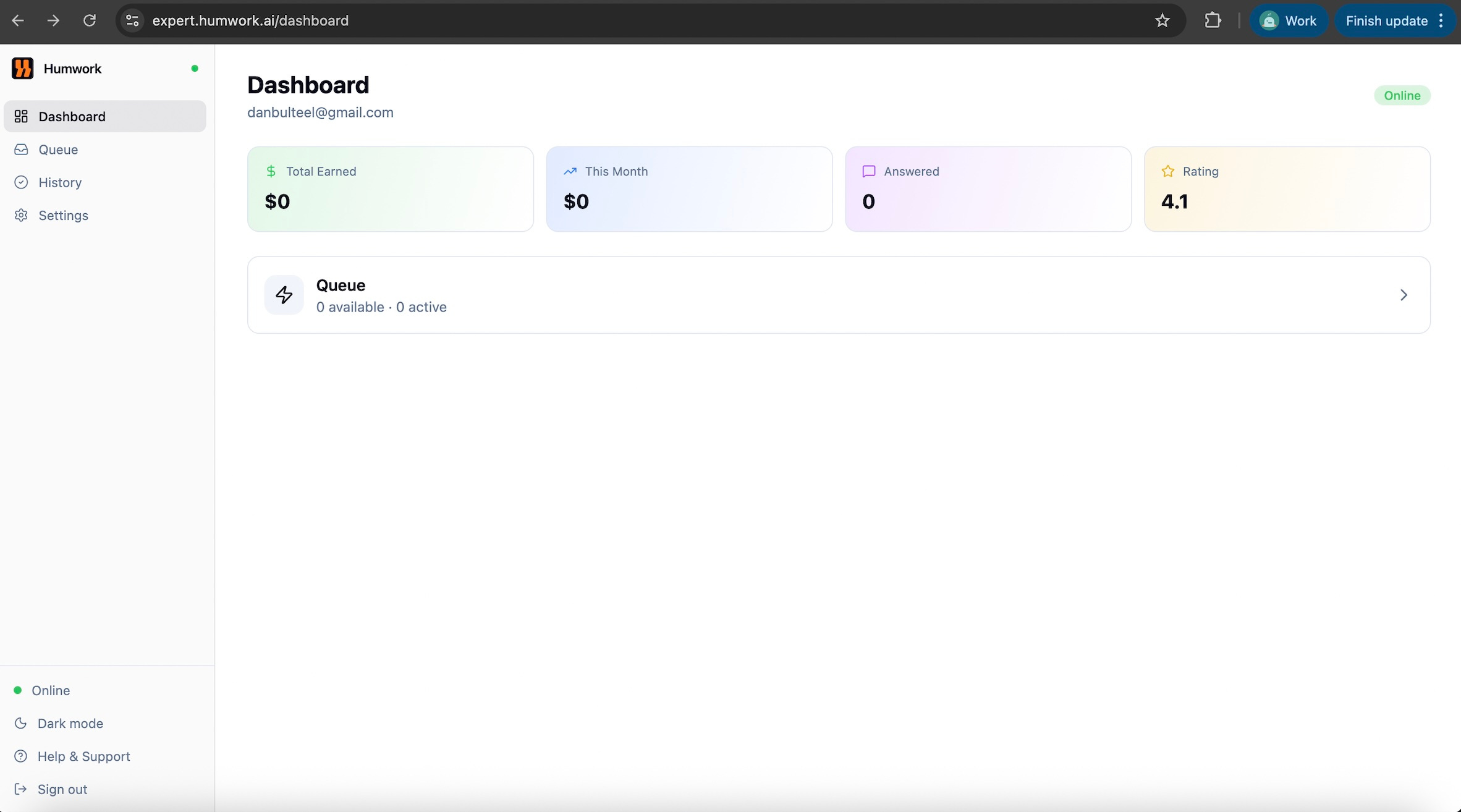
It made me wonder whether the future really belongs to lots of narrow marketing agents, or whether stronger general agents will simply seek out the right specialist knowledge in the moment when they need it?
Either way, if agents can increasingly do the work, then marketers need to get much better at defining the actual problem, writing sharper briefs and judging output honestly.
In my 17 years, I’ve met very few good communicators and brief writers. Perhaps we need a specialist “agent briefer” in the marketing team stack.
So what does marketing look like in two years?
If I was a betting man: marketing starts to feel like an auction.
It’s run by a commercially-minded generalist with a few critical human-in-the-loop specialist functions and everything else automated.
Brand becomes an opportunistic moving target chasing performance. Terms like authentic and social-first are replaced with agent outcome language.
And performance itself shifts from hyper-targeting to hyper-earning.
Agents combined with vast data from our AI interactions mean we know, at any given moment, where a brand is visible, how it’s perceived, and how that’s impacting revenue.
You know exactly what to do about it. The constraint isn’t the diagnosis. It’s the budget and media required to bid for the right agent to go and execute.
Think of it like this: your intelligence layer flags a competitor gaining ground in a specific AI recommendation channel. You know the fix. The question is whether you have the budget and creative message to deploy the agent that wins that space back - and whether the ROI justifies the bid.
Strategy stops being “what should we do?” and becomes “where is the highest-value place to act right now?”
Specialist over generalist feels like a contrarian take today, but in a world where everyone can do anything, domain expertise - taste, ingenuity, innovation - becomes the difference maker.
The human team still exists across strategy, media, creative, AEO, social, partner, community and events. The rest is machine.
Strategy steers the ship. Marketing engineers. People who connect the dots across the business, diagnose the real problem, and point the system in the right direction.
Media manages a decentralised network of placements across old and new surfaces, constantly hunting for new ecosystem opportunities.
Creative pushes for originality, distinctiveness and taste - because in a world of infinite content, this is what actually reduces cost and increases efficiency.
AEO becomes one of the primary ways brands are discovered, as voice and text, as business and consumers spend all day in a preferred LLM and connect to other apps when needed.
Social remains where people go for entertainment and identity. It’s more competitive for attention than ever.
Partner marketing relies on people talking to people - planning together, borrowing trust, reaching audiences through relationships agents can’t replicate. The partners can be creators, AI personalities or other companies.
Community still needs human oversight, because that oversight is the value signal. It shows the brand cares. It shows someone is there.
Events are organised and optimised by agents - from guest lists to outreach - but still need people on the ground. The “con” strategy accelerates: brands either build their own (adidasCon) or show up at their category’s tentpole (VibeCon).
Agents do all reporting. People do the planning and meaning-finding.
The work becomes about absolute focus. Picking the channels where you can still win.
Big companies using brute force and dollars, startups look for the gaps, like always.
I’d love to hear how you see the future of marketing so please drop a comment or DM?
Thanks for reading this far, Dan
The edge still looks like distribution to me.
If AI makes production cheaper for everyone, more of the game moves to getting seen.